Floor by Floor: Britain's Small Maltsters and the Case for Characterful Grain
Photo: Unknown, Public domain, via Wikimedia Commons
Ask a brewer what they're excited about and you'll usually get a hop variety, a yeast strain, or a fermentation trick. Ask what's actually in the beer and the answer is far duller: mostly water, then malt, then a bit of everything else. By weight, base malt typically accounts for somewhere north of 85 per cent of the grist. It is the floor the whole recipe stands on, and for the best part of forty years it has also been the most anonymous part of the process — bought by the tonne from a handful of large malting plants, spec'd for extract and colour, and rarely mentioned on the pump clip.
That's beginning to shift. Up and down the country, small maltsters are setting up in converted barns, old mill buildings and industrial units, reviving floor malting, growing heritage barley varieties under contract and selling grain with a postcode attached. It is, by any measure, a niche — but it's a niche that's quietly reshaping how British brewers talk about their beer.
The slow craft of turning barley into malt
Malting is a deceptively simple process. You steep barley in water until it thinks spring has arrived, spread it out to germinate, then dry it down in a kiln before the shoot gets too far ahead of itself. The trick is in the middle bit.
In a modern pneumatic plant, germination happens in a drum or a box with air pushed through it, temperature and moisture controlled to a decimal point. It's fast, consistent and efficient — genuinely impressive engineering. Floor malting does the same job with gravity, a cool building and a person with a shovel. The grain lies in a shallow bed, turned by hand several times a day so it doesn't mat together and overheat. It takes longer, produces smaller batches, and requires someone to be there at unsociable hours to check on it.
What you get for that labour is grain that behaves a little differently batch to batch — and, its advocates argue, tastes more of itself. Slightly deeper colour, more pronounced biscuit and cereal notes, a bit more variation in modification. Whether that difference survives fermentation and conditioning is a fair question, and one that brewers using it tend to answer with a shrug and a second pint. The aroma of a freshly cracked floor-malted grain is genuinely arresting: porridge, toasted crust, a faint sweetness. It's the smell of a bakery, not a spreadsheet.
Heritage barley and the taste of a field
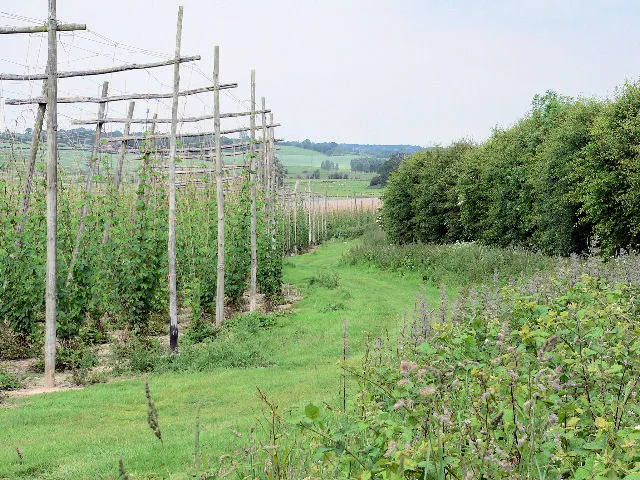
The other half of the revival is genetic. Maris Otter, released in 1966, became the default British ale malt for a reason — it's forgiving, flavoursome and it makes a decent pint. But it's far from the only option. Chevallier, a Victorian variety brought back from near-extinction by enthusiasts in the 2010s, has become something of a calling card for brewers chasing old-fashioned richness. Plumage Archer turns up in heritage grists. Golden Promise, bred in Scotland in the late 1960s, still has devotees north of the border. There are newer arrivals too — varieties bred for organic systems, for drought tolerance, for the kind of marginal land that wouldn't normally grow malting-grade barley at all.
Alongside the varieties sits the terroir argument, which is either the most interesting thing in British brewing or a load of marketing, depending on who you ask. The case goes like this: barley grown on thin chalky soil in Norfolk tastes different from barley grown in the Scottish Borders, and malt made from each should carry that through. The sceptics point out that malting and kilning are fairly brutal processes, and that a lot of subtlety gets flattened between field and fermenter.
Both can be right. What's undeniable is that provenance sells. A brewer who can put the name of a farm on the chalkboard, or the variety of the barley on the label, has a story that a generic sack of base malt simply can't tell.
Why brewers are paying over the odds
Craft malt is not cheap. Depending on variety and volume, the premium over commodity base malt can run to 20 or 30 per cent, sometimes more once you factor in smaller bag sizes, awkward deliveries and the odd batch that doesn't quite match the last one. For a brewery already squeezed by duty, energy and distribution costs, that's a real decision.
The calculation brewers seem to be making is that it's a decision worth making at the top end of the range. A core bitter on cask might stay on reliable commodity malt; a special, a barrel-aged stout, a single-hop pale where the malt is doing the talking — those get the expensive stuff. It's the same logic that has driven taproom-only releases and small-batch experiments: use the margin available in a £4.50 half to fund the interesting bit.
There's a practical benefit too. Small maltsters will take small orders, talk to you about diastatic power, and occasionally turn up at the brewery with a sample. That relationship is worth something, particularly to a brewer working with a barley variety nobody else in their postcode is using.
The awkward maths of scaling a maltings
The obvious question is whether any of this can grow. Floor malting is, almost by definition, capacity-constrained — you can only lay out so much grain on so much floor. Building new malting floors is expensive and slow, and the skills involved take time to learn. Several of the newer British maltsters have expanded, but steadily rather than spectacularly.
There's a supply wrinkle too. Malting-grade barley isn't just any barley; it needs low nitrogen, high germination and a consistent kernel size, and farmers grow it under contract for the big maltsters years in advance. A small maltster wanting 200 tonnes of a heritage variety has to find a grower willing to bet a field on it, and pay enough to make it worth their while. That's why some of the more interesting work is happening through direct farm partnerships and long-term agreements rather than spot buying.
And then there's consistency. A brewer raised on spec sheets finds batch-to-batch variation mildly terrifying. A generation of cask brewers, who learned to adjust the grist on the day, finds it entirely normal. The trade-off between character and predictability is the whole argument in miniature, and there's no tidy answer.
What a pint is standing on
None of this means the large maltsters are going anywhere — they make reliable, well-priced grain at a scale the small operators can't touch, and most British beer will keep being made from it. But the revival has done something useful. It has made malt a topic of conversation again, in the same way that single-farm coffee and heritage wheat flour made their raw materials worth asking about.
The next time a pump clip mentions a barley variety, it's worth reading it. Somewhere behind that beer is a field, a farmer, a floor and a person with a shovel who got up at five to turn the grain. That's not a bad story to have in a pint.