Picking Britain: The Brewers Betting on Home-Grown Hops
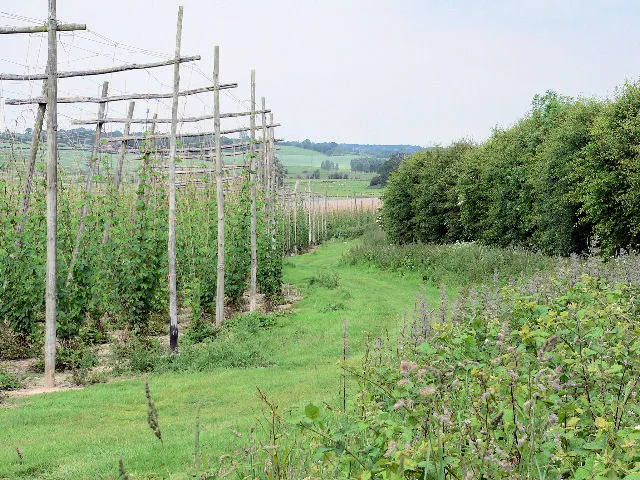
Photo: RH Dengate, CC BY-SA 2.0, via Wikimedia Commons
There is a moment on every brew day when a sack of hops is opened and the room changes. The air goes green, resinous, sometimes grassy, sometimes marmalade-sweet. For a generation of British brewers, that moment has usually meant a bag of American Citra or German Hallertau. In 2026, it increasingly means a bag with a UK grower's name on it.
That shift is not a flag-waving exercise. It is a slow, practical recalculation happening in small brewhouses from Kent to Kirkcudbright. British hops are back on the recipe sheet because they make sense: they are closer, they are more available in small lots, and they taste like the place they came from.
A quiet reconsideration, not a heritage parade
For years, the story of UK hops was told as a decline. Acreage fell, imports rose, and many brewers reached for big, tropical varieties from the Pacific Northwest. British hops were often treated as a nod to tradition: a handful of Goldings in a bitter, a dusting of Fuggles in a dark mild, then back to the louder stuff.
As of late 2026, the tone has changed. Small breweries are reworking core recipes around UK-grown hops, not just seasonal specials. They are testing them in pale ales, saisons, porters and even lagers. The motivation is partly cost and carbon, partly curiosity, and partly the simple desire to make beer that could not have come from anywhere else.
Heritage varieties, without the museum glass
Fuggles and Goldings still matter, and rightly so. Fuggles brings earthiness, woodruff and a soft hedgerow bitterness. Goldings is cleaner and more elegant, with spice and a gentle citrus lift. Neither is a novelty. Both are ingredients with a long memory.
But the new British hop story is wider than the old classics. Challenger, Progress, Bramling Cross and First Gold all have their advocates. Brewers are learning to use them with precision rather than sentiment. A Fuggles-heavy pale ale can be muddy if handled badly; used with a clean yeast and a restrained hand, it can be quietly brilliant. The point is not to recreate a 1950s bitter. The point is to find out what these hops can do in 2026.
Dwarf hops and the British weather
One of the more interesting developments is the rise of dwarf hop varieties. These are shorter plants, bred to cope with British growing conditions and to be easier to manage in the field. Less wind damage, more efficient picking, and a canopy that suits the UK's unpredictable summers.
Varieties such as Harlequin, Jester, Olicana and Endeavour have given brewers new tools. They can be bright and fruit-forward without being loud. They can carry a beer's aroma without demanding all the attention. And because they are bred for this climate, they fit into a supply chain that does not depend on a container ship.
The weather is not a bug here. It is part of the flavour. A hop grown through a damp English summer tastes different from one grown in a sun-baked valley abroad. That difference is the point.
Contracts, clusters and the local supply chain
For a small brewer, buying British hops used to be harder than it should have been. Minimum order quantities, limited availability and a hop merchant's catalogue that favoured the big buyers all got in the way. That is changing, slowly.
Growers and merchants are offering smaller lots. Brewers are clubbing together to buy a single harvest. Taprooms are hosting harvest talks. In some cases, a brewery will contract a patch of hops and then build a beer around it, which is a nice way of making the supply chain visible without turning it into a marketing gimmick.
This is where the local angle becomes real. A brewer in Yorkshire buying a few kilos of a Yorkshire-grown hop is not just telling a story. They are shortening a chain, reducing risk and learning more about an ingredient that used to arrive as an anonymous pellet.
A point of difference in a crowded market
Craft beer is not short of choices. Shelves are busy, tap lists are long, and drinkers have more information than ever. In that environment, home-grown hops offer something useful: a genuine point of difference that does not rely on a cartoon can or a fake rivalry.
But it has to taste good. A pump clip that says British hops is not enough. Drinkers will forgive a lot, but they will not forgive dull beer. The brewers making this work are the ones using UK hops with the same rigour they would apply to any imported variety: tasting, blending, adjusting, and refusing to hide behind the flag.
The alchemy test
This is alchemy in its truest brewing sense: turning soil, weather and stubbornness into a flavour that could only come from here. Not a replacement for every hop in the freezer. Not a retreat from the wider world. A rebalancing.
The hop swap is not really a swap at all. It is a return to first principles. Open the sack, smell the harvest, and ask what this place can do. In 2026, more British brewers are asking that question, and the answers are getting better every season.